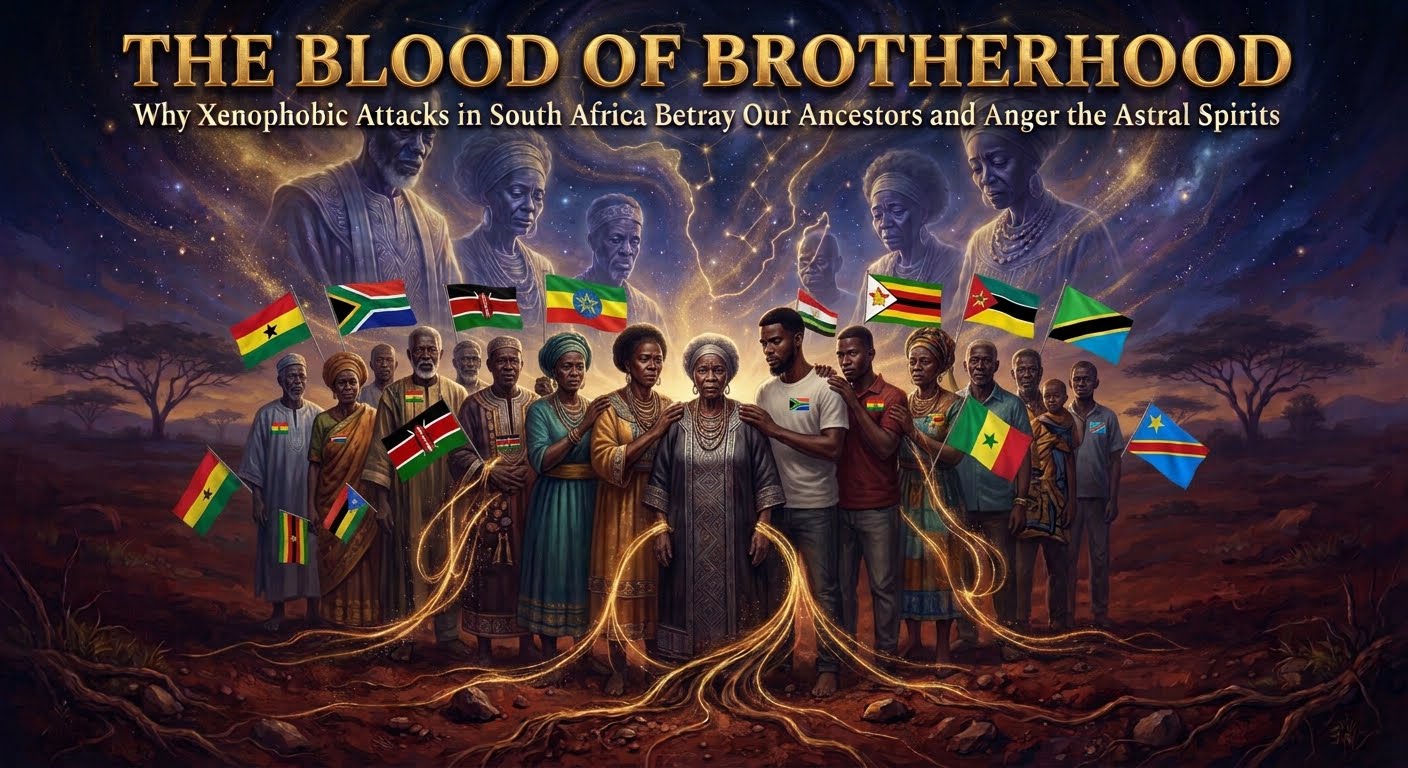

In recent years, the recurring waves of violence targeting African-owned businesses in South African townships have sparked severe sociopolitical distress. Beyond the visible destruction of property and loss of life, this violence carries a heavy, unspoken toll. For many traditionalists, spiritualists, and elders across the continent, these attacks represent a profound betrayal of the spirits of our forefathers. They violate the sacred metaphysical ties that bind all people of African descent, irrespective of modern geopolitical borders.
By weaving together sociopolitical realities and deep African metaphysics, we can see that this crisis is not just a failure of state governance—it is a catastrophic rupture of the cosmic order.
1. The Sociopolitical Rupture: Betraying the Anti-Apartheid Covenant
To understand the depth of this betrayal, one must look at the modern history of the continent. The liberation of South Africa from the shackles of Apartheid was not a localized victory; it was a collective African triumph.
- The Frontline States: Nations like Zambia, Tanzania, Zimbabwe, and Mozambique sacrificed their own economic stability and security to house, train, and protect African National Congress (ANC) freedom fighters.
- Continental Solidarity: Countries further afield, such as Nigeria, levied taxes on their own citizens to fund the anti-apartheid movement and provided passports to exiled South Africans.
When local communities attack shop owners from these very nations, it reveals a profound historical amnesia. From a sociopolitical lens, xenophobia is often triggered by systemic failures—high unemployment, poor service delivery, and poverty. However, using fellow Africans as scapegoats directly desecrates the political solidarity that birthed South Africa’s democracy.
2. The Metaphysical Rupture: Cosmic Laws and Ancestral Anger
While sociologists view these attacks through the lens of economic competition, African spirituality views them as an act of spiritual warfare against the self. In African metaphysics, the universe operates on invisible laws of balance, resonance, and energy.
The Colonial Illusion of Borders
The astral spirits and ancestors do not recognize the arbitrary lines drawn by European powers at the Berlin Conference of 1884. To the spiritual realm, an African born in Lagos, Harare, or Mogadishu carries the same primordial life force (Ashe, Chi, or Moya) as one born in Soweto or Alexandra. When an African attacks another African based on a passport, they are bowing to a colonial illusion and violating the cosmic law of oneness.
The Sacred Law of Hospitality (Ubuntu)
At the core of African metaphysics is Ubuntu (I am because we are). This is not just a social catchphrase; it is a spiritual law. In traditional architecture and culture, the traveler or stranger who comes in peace is protected by the gods of the land. Harming an innocent merchant who is simply seeking a livelihood breaks a cosmic covenant.
Blood Cries from the Soil
In African cosmology, blood holds memory and the earth is a living repository of spiritual energy. The unjust shedding of African blood by African hands creates a severe energetic discord:
- Astral Turmoil: Spiritualists and traditional healers (Izangoma and Zinyanga) warn that the astral realms become turbulent when cosmic laws are broken. The ancestors of the victims cry out for justice, while the ancestors of the aggressors veil their faces in shame, withdrawing their protection.
- The Spiritual Blight: When a community permits the destruction of a neighbor’s livelihood, it invites Isisinyithi (a spiritual darkness or cloud of bad luck). This cosmic dissonance often manifests back into the physical world as a cycle of unyielding social unrest, localized poverty, and a profound loss of collective peace. The land itself rejects the energy of hatred, causing spiritual and material stagnation.
3. Restoring Balance: A Holistic Path Forward
To heal the deep wounds of xenophobia, South Africa must look beyond mere police intervention. True healing requires an alignment of both the material and spiritual worlds.
┌─────────────────────────┐
│ COSMIC BALANCE (UBUNTU) │
└────────────┬────────────┘
│
┌────────────────┴────────────────┐
▼ ▼
┌───────────────────────┐ ┌───────────────────────┐
│ SOCIOPOLITICAL ACTIONS│ │ METAPHYSICAL ACTIONS │
├───────────────────────┤ ├───────────────────────┤
│ • Historical education│ │ • Cleansing rituals │
│ • Economic integration│ │ • Ancestral appeasement│
│ • Fair law enforcement│ │ • Spiritual healing │
└───────────────────────┘ └───────────────────────┘
- Spiritual Cleansing: Traditional leaders and spiritual elders must conduct cleansing ceremonies in affected townships to appease the angered spirits of the land and ask for forgiveness from the collective ancestors.
- Historical Education: The education system must aggressively teach the youth about the immense sacrifices made by the rest of Africa during the struggle against Apartheid.
- Economic Synergy: Shifting from conflict to collaboration, recognizing that a prosperous African diaspora strengthens local informal economies rather than depleting them.
The attacks on fellow Africans are a tragic detour from the path of Pan-African destiny. To quiet the anger of the astral realms and secure a prosperous future, we must remember that our blood is one, our history is intertwined, and our cosmic destiny remains bound together.
The Author: Mr. Edmund Zar-Zar Bargblor

MR. Edmund Zar-Zar Bargblor is a distinguished Liberian educator, author, and public servant known for his work in mathematics education and his writings on African governance and social issues. Awards and Recognition: In March 2025, he received the West Africa Intellectuals Award from the West Africa Intellectual Organization (WAIO) in Accra, Ghana, for his articles on African governance, corruption, and economic development. He is a former Deputy Managing Director of the National Port Authority of Liberia.